Three everyday dangers, three real stories and the warning signs every dog owner should know.
It only takes a few seconds
Imagine coming home to find an empty chocolate wrapper on the floor.

By Dr. Alberto Fernández Jiménez, MRCVS
Veterinary Surgeon & Co-Founder of TINAVET Marbella
Your dog is sitting beside it, wagging their tail, looking perfectly pleased with themselves.
Perhaps the chocolate belonged to your child. Perhaps it was a birthday present, a box of chocolates on the coffee table or something you had left in your handbag.
Your first reaction might be to laugh.
Then you realise what has happened.
Your dog has eaten chocolate.
And suddenly, you have a hundred questions.
How much did they eat? Is chocolate really that dangerous? Should I make them vomit? What if they seem completely fine?
Now imagine something even more ordinary.
Your child drops a grape during breakfast. Your dog catches it before it touches the floor.
Or a tablet falls from your hand while you are taking your medication. Before you can pick it up, your dog swallows it.
One small moment. One everyday accident.
And potentially, a serious veterinary emergency.
As a veterinary surgeon, I know how frightening these situations can be, especially when your pet seems healthy and you have no idea what might happen next.
My wife, Rocío, and I have spent years working in veterinary medicine, including our clinical experience in Birmingham in the United Kingdom.
Something that experience has taught us is that the most dangerous emergencies are not always the ones that look dramatic.
Sometimes a dog can be in serious danger long before showing any symptoms.
That is why we believe veterinary care should also mean helping families recognise risks before they become tragedies.
Today, I want to explain three of the most common household poisoning dangers for dogs:
Chocolate. Grapes and raisins. Human medications.
And I want to share three real, documented cases that show why the right decision at the right moment can make such a difference.
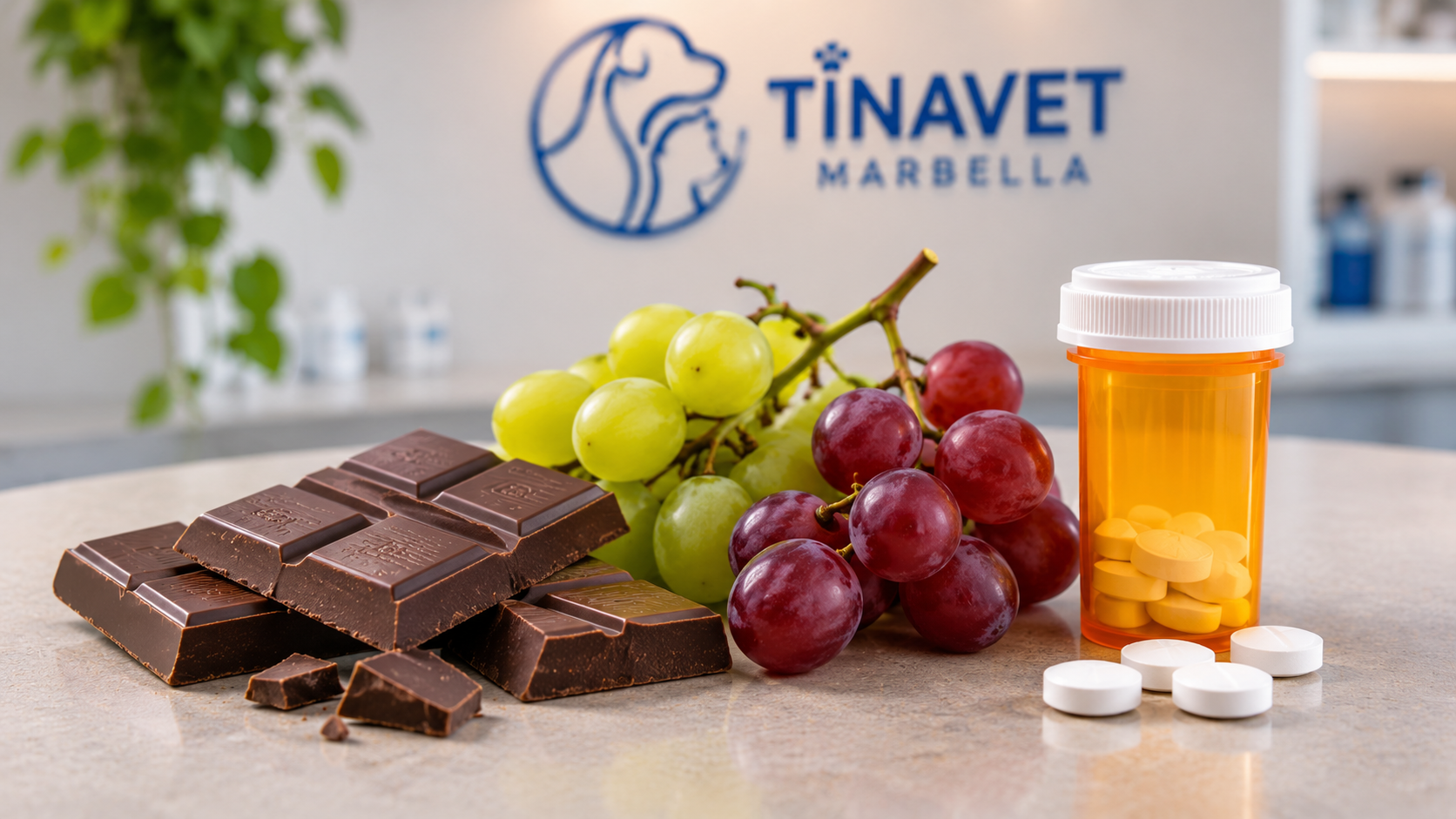
Everyday foods and human medicines can be dangerous for dogs. Dr. Alberto Fernández explains poisoning risks, warning signs and when to seek urgent veterinary care.
First: What should I do if my dog eats something toxic?
If your dog has eaten chocolate, grapes, raisins or human medication, contact a veterinarian immediately, even if your dog seems completely normal.
Do not wait for vomiting, shaking, weakness or other symptoms.
The correct response depends on what was swallowed, the amount, your dog's weight, how long ago it happened and their medical history.
For suspected grape, raisin or human medication poisoning, seek urgent veterinary advice regardless of the amount.
For chocolate, your vet can assess the risk based on the type and quantity consumed.
Five things to do immediately
Remove any remaining food or medication so your dog cannot eat more.
Keep the packaging and identify exactly what was swallowed, including ingredients and tablet strength where applicable.
Estimate how much is missing, when it happened and your dog's weight.
Call a veterinarian or an available emergency veterinary service immediately.
Follow professional instructions. Do not attempt home treatments.
Never induce vomiting, give activated charcoal, administer another medication or try home remedies unless specifically instructed by a veterinary professional.
Some treatments are helpful in selected situations, but they can be dangerous when used incorrectly.
If your dog is collapsing, having seizures, struggling to breathe or becoming unresponsive, go directly to an emergency veterinary hospital.
1. My dog ate chocolate. How dangerous is it?
Chocolate contains two substances that can be toxic to dogs:
Theobromine
Caffeine
Both belong to a group of compounds called methylxanthines.
Dogs process these substances differently from humans, allowing them to affect the heart, nervous system and other organs.
The most important thing to understand is that not all chocolate carries the same level of risk.
Which chocolate is most dangerous?
In general, chocolate products with a higher cocoa content contain more theobromine.
From greatest to lower typical concern:
Cocoa powder and baking chocolate
Dark and high-cocoa chocolate
Milk chocolate
White chocolate, which contains very little theobromine
White chocolate may still cause digestive problems because of its fat and sugar content.
The risk also depends on your dog's size.
A quantity that causes little concern in a large dog could be dangerous in a very small dog.
For this reason, it is not safe to assess chocolate poisoning simply by counting how many squares your dog has eaten.
What are the symptoms of chocolate poisoning?
Symptoms may include:
Vomiting or diarrhoea
Unusual restlessness or hyperactivity
Increased thirst
Excessive panting
A fast or irregular heartbeat
Tremors or muscle twitching
Increased body temperature
Seizures
Collapse in severe cases
Symptoms may not develop until several hours after ingestion.
A dog who appears perfectly normal immediately after eating chocolate may still need treatment.
A real case: Charlotte, the Labradoodle who ate a huge bag of chocolate
Charlotte was a Labradoodle living in Utah, United States.
One day, her owner returned home and discovered that Charlotte had eaten most of a large bag containing approximately 4.5 pounds of semi-sweet chocolate chips.
Charlotte had already vomited.
When she reached the emergency veterinary hospital, she was trembling, weak and had an elevated heart rate.
The veterinary team worked with toxicology specialists to manage the poisoning, including hospital monitoring and supportive treatment.
Fortunately, Charlotte survived.
Interestingly, the investigation also revealed an unrelated digestive condition that had been contributing to her weight loss.
Her story was publicly documented by Pet Poison Helpline.
What can we learn from Charlotte?
That you cannot judge the danger simply by looking at your dog.
The type and quantity of chocolate matter. So does the dog's weight.
And early veterinary assessment can be crucial.
2. My dog ate grapes or raisins. Can just one be dangerous?
This surprises many dog owners.
Grapes are healthy for people.
They are commonly found in family kitchens, fruit bowls, lunchboxes and children's snacks.
But grapes and raisins can cause severe kidney injury in dogs.
The risk also applies to sultanas and related dried grape products.
One of the most worrying aspects is that the amount capable of causing harm cannot be reliably predicted for an individual dog.
Some dogs develop serious complications after relatively small amounts, while others do not.
That does not mean the grapes were safe.
It means individual susceptibility varies.
Researchers have identified tartaric acid and related compounds as leading explanations for this toxicity, although important questions remain about individual sensitivity.
What happens inside the body?
The kidneys are responsible for filtering waste products from the blood and maintaining the body's fluid and electrolyte balance.
In susceptible dogs, grape or raisin poisoning can damage kidney cells.
As kidney function deteriorates, dangerous waste products and electrolyte disturbances may develop.
Severe cases can progress to acute kidney failure.
Symptoms of grape or raisin poisoning
Possible warning signs include:
Vomiting
Diarrhoea
Loss of appetite
Abdominal discomfort
Weakness or unusual tiredness
Increased thirst
Changes in urination
Reduced or absent urine production in severe cases
Some early symptoms may appear within hours.
Kidney injury can develop later, sometimes over the following one to three days.
This is why you should never wait until your dog starts vomiting or stops urinating.
A real case: the Sheltie who ate raisins
Pet Poison Helpline reported the case of a Sheltie in Pennsylvania that swallowed raisins before its owner could stop it.
Fortunately, the owner sought professional toxicology advice immediately.
Following the instructions of the specialists, the raisins were successfully removed before they caused apparent harm.
The case was shared in a veterinary safety article about the dangers of attempting to make pets vomit without guidance.
You can read the documented case here.
The lesson is not to make your dog vomit at home.
The lesson is that the owner contacted a professional immediately and received advice appropriate to that specific situation.
Inducing vomiting incorrectly can cause additional injury.
What if my dog ate only one grape?
You should still contact a veterinarian immediately.
There is no reliably established safe quantity of grapes or raisins for every dog.
Do not assume a small amount is harmless, and do not rely on the fact that your dog has eaten grapes before without becoming ill.
3. My dog swallowed a human medication. What should I do?
Of these three situations, this is one that deserves particular attention in homes with children, grandparents, visitors or people who take daily medication.
Think about how easy it is for an accident to happen.
A tablet falls from a kitchen worktop.
A child leaves a medicine bottle open.
A handbag containing painkillers is left on the sofa.
A dog discovers a blister pack under the bed.
And before anyone notices, the medication has disappeared.
One of the biggest mistakes owners make is assuming that medicine which is safe for humans must also be safe for their pets.
A dog's body processes many medications differently from ours.
Some human medicines can cause serious poisoning even after a small exposure.
Ibuprofen
Ibuprofen is widely used by people to relieve pain and inflammation.
In dogs, inappropriate exposure can cause:
Vomiting and diarrhoea
Stomach or intestinal ulcers
Gastrointestinal bleeding
Kidney damage
Weakness or neurological symptoms
Seizures in severe poisonings
Ibuprofen should never be given to a dog unless specifically prescribed and supervised by a veterinarian.
Paracetamol (acetaminophen)
Paracetamol is another extremely common household medicine.
It can cause serious liver injury and other complications in dogs when given inappropriately or in overdose.
It is especially dangerous to cats, which are much more vulnerable to its toxic effects.
Never give paracetamol to a dog or cat without veterinary direction.
Naproxen and other anti-inflammatory medicines
Naproxen, diclofenac and other human anti-inflammatory drugs can also be dangerous.
Some can remain in a dog's body for a prolonged period, increasing the risk of serious complications.
Other medicines
Prescription medicines for attention disorders, depression, heart conditions, diabetes, sleep or other illnesses can also cause severe adverse effects when swallowed by pets.
The risks vary widely depending on the active ingredient and dosage.
For this reason, always tell the veterinarian the exact name and strength of the medication.
A real case: Abby, the dog who swallowed nearly 500 ibuprofen tablets
Abby's story is extraordinary.
Her owner, living in Wisconsin, United States, came home one night and noticed that something was wrong.
Abby had discovered a container of ibuprofen that had been left on a table.
The dog had managed to open it and swallow nearly 500 caplets.
Her owner immediately contacted veterinary emergency services.
Despite initial treatment, Abby's condition deteriorated rapidly.
She developed serious neurological problems and changes suggesting organ injury.
Veterinary specialists recommended an advanced treatment called intravenous lipid emulsion, selected for this exceptional, life-threatening case.
After intensive care, Abby recovered.
Her story is documented by Pet Poison Helpline.
The treatment used in Abby's case is not routine or suitable for every poisoning.
But her experience demonstrates something vital.
A pet can deteriorate dramatically after initially appearing relatively normal.
It also shows why rapid access to veterinary treatment and toxicology expertise can make such an important difference.
4. Poisoning or swallowing an object: what is the difference?
This is an important distinction.
In our previous article, What to Do If Your Dog or Cat Swallows Something They Shouldn't, I explained the risks associated with objects such as pacifiers, socks, plastic toys, bones and ribbons.
These objects can cause a foreign body obstruction.
In other words, they may become physically trapped in the digestive system.
Poisoning is different.
A dog who eats chocolate, grapes or human medication may absorb harmful substances into the bloodstream.
These substances can then affect organs such as the heart, kidneys, liver or brain.
Sometimes both dangers occur together.
For example:
A dog eats chocolates together with their wrappers.
A dog swallows a blister pack containing tablets.
A dog eats chocolate-covered raisins.
In these situations, the veterinarian must assess both possible toxicity and physical injury or obstruction.
That is why identifying exactly what your pet swallowed is so important.
5. What will the veterinarian do if my dog has been poisoned?
There is no single treatment for every poisoning.
The first step is to identify the suspected substance and assess the risk.
The veterinary team may consider:
Clinical examination
We assess your pet's condition, including heart rate, breathing, hydration, neurological signs and any discomfort.
Blood tests
Blood tests may help evaluate kidney function, liver function, blood glucose, electrolytes and other relevant parameters.
Veterinary-supervised decontamination
In selected cases, treatment may involve inducing vomiting or administering activated charcoal.
These are clinical decisions.
Vomiting is not appropriate for every toxin, every patient or every stage of poisoning.
Intravenous fluids
IV fluids may be recommended when clinically indicated, especially when there is a risk of kidney injury or dehydration.
Medication and supportive care
Specific treatment may be required to control vomiting, seizures, dangerous heart rhythms, gastrointestinal injury or other complications.
Certain toxins have specific antidotes or targeted treatments.
Others do not.
Hospitalisation and monitoring
Some dogs need observation and repeated examinations or laboratory tests, even if their first results appear normal.
This can be especially important after grape or raisin ingestion because kidney injury may not be immediately detectable.
The earlier a dog is assessed, the more treatment options may be available.
6. Seven common mistakes that can make poisoning more dangerous
Many of these mistakes happen because owners are frightened and want to help.
But good intentions do not always lead to safe decisions.
Mistake 1: Waiting for symptoms
Some toxins cause damage before obvious clinical signs develop.
Mistake 2: Searching for a safe dose instead of calling a veterinarian
Online calculators and general articles cannot fully assess your dog's individual circumstances.
Mistake 3: Trying to induce vomiting at home
Salt, hydrogen peroxide and other home remedies can cause serious complications.
Only follow a specific veterinary professional's instructions.
Mistake 4: Giving milk, oil or food to neutralise the poison
These are not reliable antidotes and may complicate treatment.
Mistake 5: Throwing away the packaging
The packaging may contain essential information about ingredients, concentrations and tablet strengths.
Mistake 6: Assuming that because it happened before without consequences, it is safe
This is particularly dangerous with grapes and raisins.
Mistake 7: Using a website contact form for an emergency
An online message may not be read immediately.
For suspected poisoning, contact an available veterinary emergency service directly.
7. Prevention: protecting dogs in homes with children
I particularly want to speak to families with young children.
Children love sharing.
A child sees their dog looking up at them with those irresistible eyes and naturally wants to give them a treat.
Sometimes it is a biscuit.
Sometimes it is a piece of chocolate.
Sometimes it is a grape.
The child is trying to be kind.
But the consequences may be serious.
I believe prevention becomes easier when we teach children one simple rule:
"We only give our pets food or medicine that Mum, Dad or the vet says is safe."
There are also practical steps that can make a real difference:
Keep chocolate, grapes and raisins away from pets, including food left in children's bags or on low tables.
Store all human medication in closed cupboards or secure containers.
Never leave tablets loose in handbags, bedside tables or on kitchen worktops.
Ask visitors to keep medication and sweets out of reach.
Teach children not to share their snacks with pets.
Check ingredients in sugar-free sweets, chewing gum and other products for xylitol.
Keep packaging from medicines and unusual foods until you know what your pet may have eaten.
Use bins with secure lids.
Keep a veterinary emergency contact readily available.
For families living in Marbella, San Pedro de Alcántara, Guadalmina, Nueva Andalucía or Puerto Banús, these precautions are just as relevant at home, in holiday apartments or when guests are visiting.
8. What other common foods can poison dogs?
Although chocolate and grapes are among the best-known hazards, they are not the only ones.
Other potentially dangerous substances include:
Xylitol: Also called birch sugar, this sweetener is found in some sugar-free foods and products. It can cause dangerous hypoglycaemia and sometimes liver injury in dogs.
Onions and garlic: In sufficient quantities, these can damage red blood cells and cause anaemia.
Macadamia nuts: These can cause weakness, vomiting, tremors and other neurological signs in dogs.
Caffeine: Coffee beans, coffee grounds and high-caffeine products can cause poisoning.
Alcohol: Even relatively small quantities may be dangerous, particularly in smaller animals.
Remember that the level of risk varies by substance, amount and animal.
If you are uncertain whether something is toxic, obtain veterinary advice rather than assuming it is safe.
9. A personal message from Alberto
As veterinarians, Rocío and I care deeply about the relationship between families and their animals.
One of the reasons we founded TINAVET Marbella was our belief that veterinary medicine should be personal, compassionate and understandable.
I never want an owner to feel embarrassed about asking a question.
Especially when an accident happens.
Dogs are curious.
They explore with their noses and mouths.
They investigate shopping bags, children's toys, kitchen cupboards and the smallest crumbs left on the floor.
Sometimes they make terrible decisions.
And sometimes they do it while looking incredibly pleased with themselves.
But what happens next depends on us.
On whether we recognise the danger.
On whether we act quickly.
On whether we ask for professional help before the situation becomes worse.
The three real stories I have shared demonstrate three different outcomes and an important common lesson.
Charlotte's chocolate poisoning required emergency treatment.
The Sheltie's raisin exposure was addressed rapidly, before apparent harm developed.
Abby's severe ibuprofen poisoning required specialised intensive care.
None of those situations should be taken lightly.
And all three remind us that early professional advice can save lives.
My message is simple:
If your dog has eaten something potentially toxic, please do not wait to see what happens.
Make the call.
Get the advice.
Give your dog the best possible chance.
Because those curious eyes, that wagging tail and that unconditional love are worth protecting.
Veterinary advice for dog owners in Marbella and the Costa del Sol
At TINAVET Marbella, Rocío and I are committed to helping families understand their pets' health and make informed decisions about preventive care, symptoms and treatment.
Our clinic is located in San Pedro de Alcántara, serving pet owners in Marbella, Guadalmina, Nueva Andalucía, Puerto Banús and neighbouring communities.
We communicate in English and Spanish.
For routine veterinary consultations and non-urgent concerns, you can contact TINAVET Marbella.
If your pet has swallowed chocolate, grapes, raisins, human medicine or another potentially toxic substance, contact an available veterinary emergency service immediately. Do not wait for an online reply.
Frequently Asked Questions About Dog Poisoning
My dog ate chocolate but seems fine. Should I worry?
Yes. Chocolate toxicity depends on the type and amount eaten and your dog's weight. Symptoms may be delayed. Contact a veterinarian promptly with the packaging and an estimate of the amount consumed.
Can one grape kill a dog?
There is no reliably established safe amount for every dog. Some dogs are more susceptible than others. Any grape or raisin ingestion should be treated as potentially serious and discussed immediately with a veterinarian.
What should I do if my dog ate raisins?
Contact a veterinarian or an emergency veterinary service immediately, even if your dog appears healthy. Do not induce vomiting unless specifically instructed by a veterinary professional.
My dog swallowed an ibuprofen tablet. Is it dangerous?
It can be. The risk depends on the tablet strength, amount consumed and your dog's size and health. Ibuprofen can cause gastrointestinal bleeding and kidney injury. Seek urgent veterinary advice.
Can I give my dog paracetamol?
Never give paracetamol to your dog unless a veterinarian has specifically prescribed it. Inappropriate doses can cause serious poisoning. Paracetamol is particularly dangerous for cats.
How quickly do poisoning symptoms appear in dogs?
It depends on the substance. Some signs develop within hours, while kidney or liver injury may become apparent later. Do not wait for symptoms before seeking advice.
Should I make my dog vomit after eating chocolate or medication?
Not without direct veterinary instructions. Inducing vomiting may help in selected cases, but it can also cause harm or be inappropriate for the substance or animal involved.
Can milk or food neutralise poison in dogs?
No. Milk, oil, bread and other home remedies are not reliable treatments for poisoning. They can delay appropriate veterinary care.
How do vets treat chocolate poisoning?
Treatment depends on the exposure and symptoms. It may include veterinary-supervised decontamination, monitoring, IV fluids and medications to manage cardiac or neurological complications.
Can my dog recover completely from poisoning?
Many dogs recover well with timely, appropriate treatment, but the prognosis depends on the toxin, dose, speed of treatment and whether organ damage has occurred.
Is chocolate poisoning the same as swallowing a toy?
No. Chocolate poisoning involves toxic substances absorbed into the body, while swallowed toys may cause a physical digestive obstruction. Some incidents involve both risks and require veterinary assessment.
Related TINAVET Marbella Articles
What to Do If Your Dog or Cat Swallows Something They Shouldn't
Meet Dr. Alberto Fernández Jiménez and Dr. Rocío Cromstedt Lavigne
Veterinary Sources and Real Case References
Medical disclaimer: This article provides general veterinary education and cannot replace an individual veterinary examination or emergency treatment. The three real cases were documented by Pet Poison Helpline and are not presented as patients treated by TINAVET Marbella.
Written by Dr. Alberto Fernández Jiménez, MRCVS — Veterinary Surgeon & Co-Founder, TINAVET Marbella.